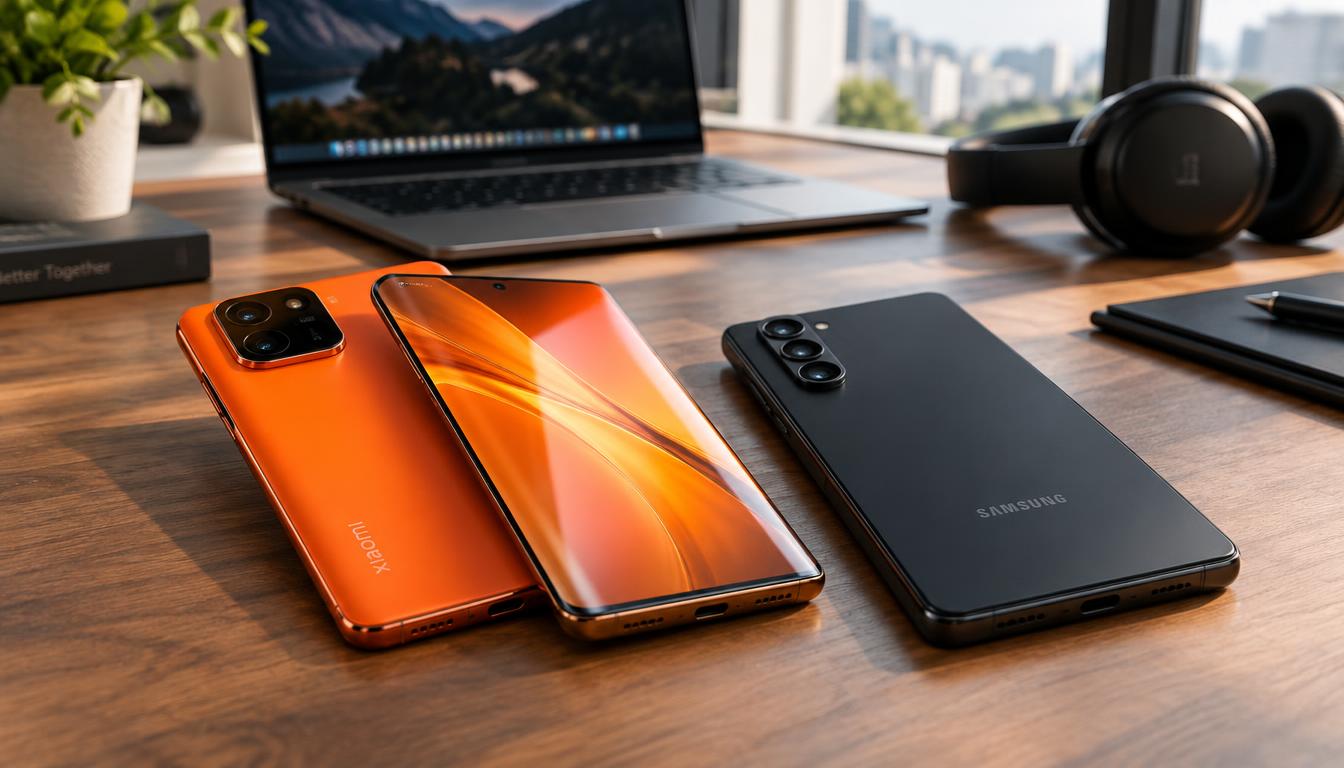
A global flagship phone may not suit U.S. buyers without local warranty coverage or full carrier support. That is why a Xiaomi vs Samsung smartphone comparison should examine more than specs and price.
Xiaomi often delivers strong hardware value, large batteries, and fast charging. Samsung offers One UI, broad U.S. availability, and long software support for the Galaxy S25 series. The best phone for us depends on the exact models, their current prices, and the features we value most.
Specs and prices can vary by model and market, so check current U.S. listings before buying. These are the main points to consider when comparing the two brands.
Key Takeaways
- Xiaomi can offer strong hardware and fast charging for the price.
- Samsung stands out for One UI and its connected device ecosystem.
- Software support differs by model, so we should check each phone’s policy.
- U.S. availability, carrier compatibility, and warranty terms matter.
- The right choice depends on our budget and most-used features.
How to Choose Between Xiaomi and Samsung
A useful Xiaomi vs Samsung comparison starts with your budget and phone habits. Compare similar models, not only brand names. This keeps differences in features and price clear.
Set a budget and identify your must-have features
Set a price range, then list the features you need most. You might value camera quality, battery life, storage, or a bright screen. A lower price may bring trade-offs in support or U.S. availability.
Compare phones in the same category and generation
Match flagship phones with flagships and budget models with budget models. For example, compare the Xiaomi 17 with the Galaxy S25, not a Poco budget phone. Reported Xiaomi 17 prices start around $800 to $859 globally; the Galaxy S25 is listed around $799 to $899.
These are not confirmed U.S. retail prices.
Consider U.S. availability, carrier compatibility, and warranty coverage
U.S. availability can vary by model. Before ordering, check network bands, warranty terms, seller support, and whether Google Mobile Services are installed. Xiaomi phones made for China may not include Google services.
Also check the seller’s privacy terms; Xiaomi’s privacy policy explains how personal information may be used.
| What to check | Why it matters |
|---|---|
| Phone category and generation | Creates a fair comparison of features and price. |
| U.S. carrier bands | Helps confirm the phone can connect to your carrier. |
| Warranty and seller support | Clarifies who can help if the phone needs service. |
| Google Mobile Services | Confirms access to familiar Google apps and services. |
Xiaomi vs Samsung: Key Differences at a Glance
A Xiaomi vs Samsung hardware comparison often focuses on price, charging, software, and local support. Redmi phones offer premium features at lower prices, while Samsung provides familiar software and wider U.S. support.
Hardware and value: more features for the price
Some Redmi models combine AMOLED displays, high refresh rates, large batteries, and fast charging. Select models support charging up to 120W, while 108-megapixel cameras appear below flagship prices. Xiaomi may include a charger and case in the box, but Samsung removed chargers from some phone packages.
Past flagship models show different priorities. The Xiaomi Mi 11 and Galaxy S21 comparison highlights the Mi 11’s larger, sharper screen and faster charging, alongside Samsung’s camera tools.
Software and support: HyperOS versus One UI
One UI has a polished, intuitive layout. HyperOS replaced MIUI and offers themes, gesture controls, and battery management. Both can feel smooth daily, but their designs and settings differ.
Xiaomi’s developer community and custom ROMs may keep some phones useful beyond official support. Community updates are not guaranteed manufacturer updates, so check each model’s policy.
Availability and ecosystem: imported Xiaomi models versus Samsung’s broad U.S. presence
Samsung sells widely in the United States and connects phones with Galaxy watches, tablets, and PCs. Its ecosystem includes Knox security and Galaxy AI, while Xiaomi flagship models and service options can vary by market. Imported phones may require extra checks for warranty and network compatibility.
| What matters | Xiaomi | Samsung |
|---|---|---|
| Value hardware | Some Redmi models offer fast charging, high-refresh AMOLED screens, and high-resolution cameras at lower prices. | Some features, such as chargers, may not be included in the box. |
| Software | HyperOS offers themes, gesture controls, and battery tools. | One UI is polished and designed to be intuitive. |
| Support and ecosystem | Community ROMs may extend use, but do not replace official updates or warranty service. | Broad U.S. availability, Galaxy device links, Knox security, and Galaxy AI. |
Compare Smartphone Specs and Performance
Processor, memory, and storage shape how a phone handles apps, games, and large files. These smartphone specs offer a useful starting point, but real-world performance depends on the model and test conditions.
Check the processor, memory, and storage
Reports list the Xiaomi 17 with a Snapdragon 8 Elite Gen 5 chip, 12GB or 16GB of RAM. It uses UFS 4.1 storage and starts with 256GB. The standard Galaxy S25 reportedly uses a Snapdragon 8 Elite for Galaxy chip and 12GB of RAM.
It starts with UFS 4.0 storage and 128GB. These details can vary by region. Before buying in the U.S., check the exact model listing.
A processor comparison matters, but RAM and storage affect multitasking and space for apps, photos, and games.
Assess everyday speed, gaming, and sustained performance
Hands-on reports describe the Xiaomi 17 as smooth during demanding daily use and gaming. The Xiaomi 15T Pro uses a MediaTek Dimensity 9400+ and reportedly trails the Snapdragon 8 Elite chips slightly. However, it stays responsive during everyday tasks.
Test results can change with game settings, heat, and software updates. A Xiaomi 17 Ultra review reported 120 frames per second in Call of Duty: Mobile at low settings. It reported 70 at maximum settings.
Those figures reflect that phone and test setup, not a direct comparison with the Galaxy S25.
Compare representative models, such as the Xiaomi 17 and Galaxy S25
For Xiaomi 17 vs Galaxy S25, compare the full setup, not just the chip name. The Xiaomi’s reported base storage is larger, while both standard models list 12GB of RAM.
| Specification | Xiaomi 17 | Samsung Galaxy S25 |
|---|---|---|
| Reported processor | Snapdragon 8 Elite Gen 5 | Snapdragon 8 Elite for Galaxy |
| Reported memory | 12GB or 16GB RAM | 12GB RAM |
| Reported storage type | UFS 4.1 | UFS 4.0 |
| Reported starting storage | 256GB | 128GB |
| What to verify | Regional configuration and available storage options | Regional configuration and available storage options |
Display Quality, Design, and Durability
In a screen comparison, the Xiaomi 17 has a 6.3-inch AMOLED display with 2656 by 1220 resolution. The Xiaomi 17 has a 120Hz refresh rate and reported peak brightness of 3,500 nits. The Galaxy S25 has a 6.2-inch Dynamic AMOLED 2X panel, 2340 by 1080 resolution, 120Hz, and up to 2,600 nits.
These display features show different strengths. The Xiaomi vs Samsung differences show Xiaomi favors brightness, while Samsung favors color tuning and anti-reflection. Screen size and resolution may matter as much as brightness for reading, streaming, or outdoor use.
For durability, listings show IP68 water and dust resistance for both phones, though Xiaomi 17’s rating is marked as expected. Samsung lists Armor Aluminum and Gorilla Glass Victus 2 for the Galaxy S25. Check the protection rating and materials for the exact U.S. model, since specifications can vary by region.
Camera Features and Photo Performance
A useful camera comparison checks more than sensor counts. It compares lenses, image processing, zoom, and video quality. These camera features shape photo performance in daily use.
Compare main, ultrawide, telephoto, and selfie cameras
The Xiaomi 17 lists three 50MP rear cameras: a main, ultrawide, and telephoto lens. Its front camera is 50MP. The Galaxy S25 pairs a 50MP main camera with a 12MP ultrawide, a 10MP telephoto with 3x optical zoom, and a 12MP selfie camera.
Higher-tier models change the comparison. The Galaxy S25 Ultra has a 200MP main camera, a 50MP ultrawide, and two telephoto cameras with 3x and 5x optical zoom. Xiaomi 17 Pro models include Leica collaboration.
Look beyond megapixels at image processing, zoom, and low-light results
Reviews of the Xiaomi 17 Ultra describe a 50MP, 1-inch OmniVision main sensor and a 200MP telephoto camera. Its mechanical optical zoom shifts from an equivalent 75mm to 100mm, or about 3.2x to 4.3x. The review reports optical-quality zoom up to 17.2x and praises detail, color, skin tones, dynamic range, and background blur.
For a fair camera comparison, check how each phone handles dim scenes and changing light. Hands-on reviews reveal more about processing and real zoom quality than megapixel counts alone.
Consider video quality and the camera features you’ll actually use
Samsung’s S25 Ultra is noted for consistent image processing and strong video recording. Xiaomi 17 Ultra reviews praise its still photos, but note less impressive video color and low-light footage. We should weigh these camera features against the photos and videos we take most.
Battery Life and Charging Speeds
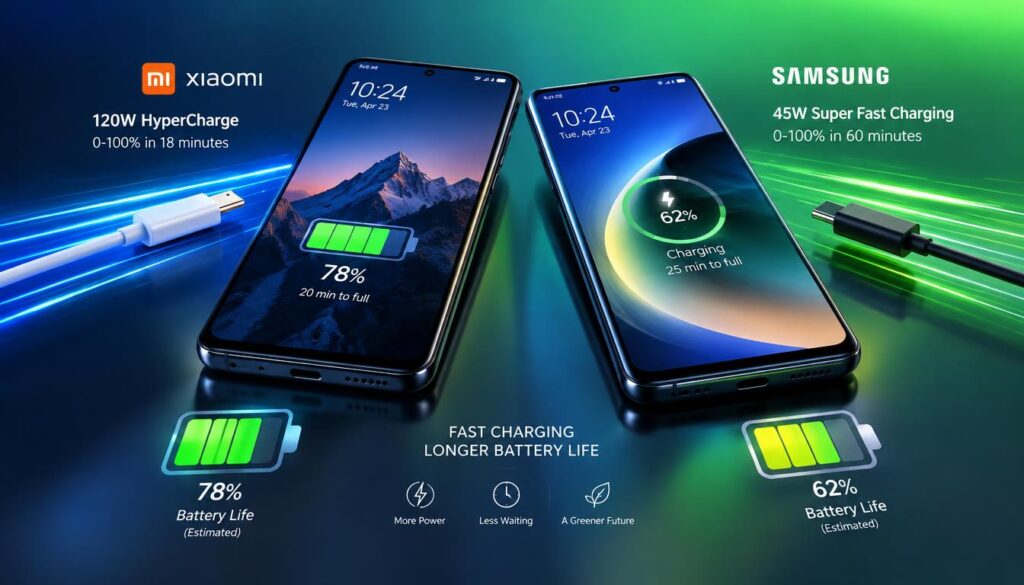
Battery capacity and charging specs suggest daily endurance, but real-world battery life depends on screen use, signal strength, and habits. In this Xiaomi vs Samsung comparison, reported figures show Xiaomi favoring larger batteries and higher charging speeds. Check the exact U.S. model before buying because specs can vary by region.
Compare battery capacity and real-world endurance
The standard Xiaomi 17 is listed with a 7,000mAh battery, compared with 4,000mAh in the Galaxy S25. In one Xiaomi 17 review, moderate camera use and streaming left about 30% charge by evening. The Xiaomi 17 Ultra review recorded eight hours of screen-on time, with up to two days possible under lighter use.
Check wired, wireless, and reverse wireless charging support
Reported specs list the Xiaomi 17 at 100W wired and 50W wireless charging; the Galaxy S25 is listed at 25W and 15W. The Xiaomi 17 Pro Max is listed with 7,500mAh capacity, 100W wired, 50W wireless, and 22.5W reverse wireless charging. The Galaxy S25 Ultra is listed at 5,000mAh, 45W wired, 15W wireless, and 4.5W reverse wireless charging.
Weigh Xiaomi’s faster-charging options against Samsung’s charging approach
A Xiaomi 17 review reported a charge from 0% to 65% in 30 minutes with a compatible 100W power source. Xiaomi suits people who value quick top-ups, while Samsung offers lower listed speeds. Charging affects daily convenience, but it is only one part of phone performance.
Software, Updates, and Ecosystem Features
Software shapes how a phone feels long after setup. In the HyperOS vs One UI comparison, compare daily controls, support terms, privacy tools, and device connections.
Compare Xiaomi HyperOS with Samsung One UI
HyperOS 3 offers gesture controls, battery tools, and flexible home-screen settings. Its HyperIsland hub puts live activities in one area. Some Xiaomi phones may include preinstalled apps, so check reviews for the exact model.
Samsung’s One UI includes Galaxy AI tools, Gemini, Writing Assist, Drawing Assist, and Call Transcripts. The Now Bar and Now Brief show useful updates on screen. Samsung Knox adds security features to the Galaxy experience.
Review OS upgrade and security update commitments for the specific model
Software updates vary by phone and region. Samsung lists seven years of OS and security support for the Galaxy S25. Xiaomi’s 17 Ultra has been reported with five OS upgrades and six years of security updates.
Check the official terms before buying.
Consider AI tools, customization, privacy, and cross-device features
Both brands offer useful AI features and ways to customize the interface. Samsung connects phones with Galaxy watches, tablets, and PCs, while Xiaomi links phones, tablets, and computers. Available features can differ by device.
For an ecosystem comparison, consider your current devices and the privacy controls that matter to you. Support length and app cleanup can shape your experience as much as new features.
| Feature | Xiaomi HyperOS | Samsung One UI |
|---|---|---|
| Interface and tools | HyperOS 3 offers gesture controls, battery management, and HyperIsland. | One UI includes Now Bar, Now Brief, and Galaxy AI tools. |
| Support example | Xiaomi 17 Ultra has been reported with five OS upgrades and six years of security updates. | Galaxy S25 is listed with seven years of OS and security updates. |
| Connected devices | Features are developing across Xiaomi phones, tablets, and computers. | Integration spans Galaxy phones, watches, tablets, and PCs. |
| What to check | Confirm the exact model’s support terms and review preinstalled apps. | Confirm support terms and the features available in your region. |
Price, Value, and Ownership Costs
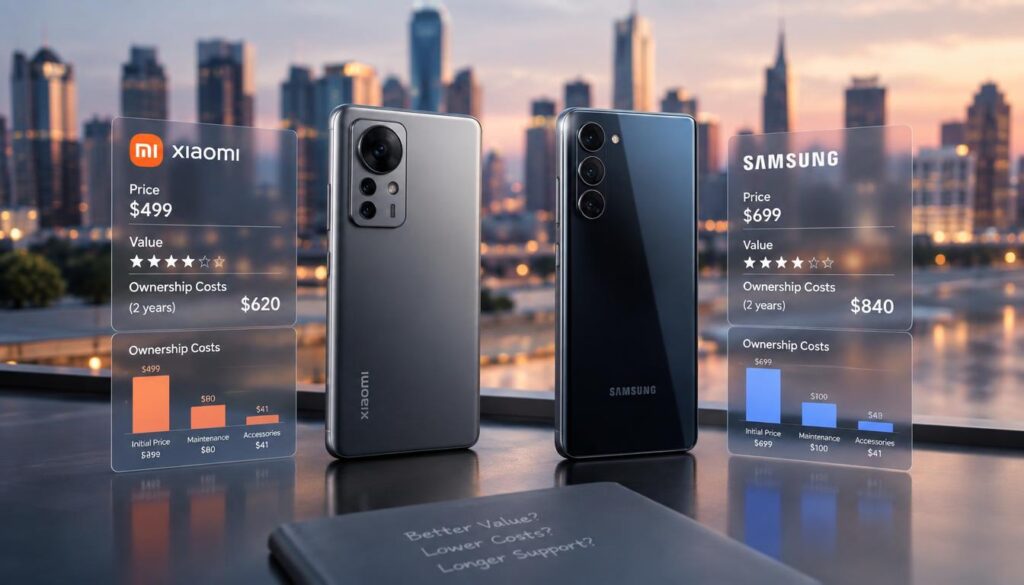
Estimated global starting prices place the Xiaomi 17 at about $800 to $859 and Samsung Galaxy S25 at about $799 to $899. The Xiaomi 17 Pro Max is estimated at $842 to $982, while Galaxy S25 Ultra costs about $1,299 to $1,660.
| Phone | Estimated starting price | Pricing context |
|---|---|---|
| Xiaomi 17 | $800–$859 | Estimate converted from Chinese yuan; global costs may be higher. |
| Samsung Galaxy S25 | $799–$899 | Estimated market MSRP range. |
| Xiaomi 17 Pro Max | $842–$982 | Estimate converted from Chinese yuan; global costs may be higher. |
| Samsung Galaxy S25 Ultra | $1,299–$1,660 | Estimated market MSRP range. |
These estimates do not guarantee U.S. prices. Taxes, import costs, and retailer offers can change the phone price. For a fair Xiaomi vs Samsung price comparison, check current U.S. listings for the exact model and storage size. A review listed Xiaomi 17 Ultra at £1,299 or AU$1,799, while Poco X8 Pro Max starts at $469 in U.S.
Our value comparison should go beyond the checkout price. Warranty coverage, local repair options, accessories, and official software support can shape ownership costs over time. Confirm these details before buying.
Which Phone Is Best for Your Needs?
The best Xiaomi or Samsung phone depends on what matters most to us. Xiaomi packs strong features and fast charging into its price, while Samsung offers One UI, support, and Galaxy tools.
Choose Xiaomi for competitive hardware, customization, or fast charging
Xiaomi Redmi models can offer strong specs for the money, and HyperOS gives us room to customize. The Poco X8 Pro Max focuses on battery life and fast charging and costs $469 in the U.S. Its large battery and capable processor suit gaming, though it is not a camera-focused pick.
Choose Samsung for One UI, long-term software support, or ecosystem integration
Samsung may fit us better if we value One UI, Galaxy AI, Knox, or links to other Galaxy devices. Specific models may offer long software support; we should check the policy for the phone we plan to buy. DeX and the S Pen on Ultra models add tools for work and note-taking.
Match the model to your priorities, whether they’re cameras, gaming, battery life, or a compact design
Compare exact models instead of assuming each brand has the same strengths. The Xiaomi 17 pairs a 6.3-inch display with a 6,330mAh battery and three 50MP rear cameras. Samsung’s Galaxy S25 has a 6.2-inch display, while the Xiaomi 17 Ultra targets camera fans with a 200MP telephoto camera.
For gaming, compare processor performance and heat in reviews. For everyday use, check battery life, camera results, size, and U.S. warranty terms.
| Priority | Model to consider | Why it may fit |
|---|---|---|
| Value and battery life | Poco X8 Pro Max | Listed at $469 in the U.S., with an 8,500mAh battery, 12GB of RAM, and a MediaTek Dimensity 9500s processor. |
| Compact flagship use | Xiaomi 17 or Samsung Galaxy S25 | The Xiaomi 17 has a 6.3-inch display and three 50MP rear cameras; the Galaxy S25 has a slightly smaller 6.2-inch display. |
| Camera-focused flagship | Xiaomi 17 Ultra | Its 6.9-inch display and 200MP telephoto camera suit buyers who prioritize zoom and photography. |
How to Use Reviews Before You Buy
Reviews show how a phone performs beyond its spec sheet. When comparing Xiaomi reviews and Samsung reviews, check each tester’s methods and whether conditions match your needs.
Look for hands-on tests of battery life, cameras, and performance
Give more weight to hands-on performance tests than brief first impressions. Look for camera samples, demanding games, multitasking, battery endurance, and charging checks. Tests lasting a week or longer can reveal more about daily use.
One Xiaomi 17 review reported smooth gaming and about 30% battery remaining most evenings. Using a 100W power source, the phone reached 65% charge in 30 minutes.
Compare review findings with the phone’s U.S. price and warranty terms
Match review results with the phone’s current U.S. price, rather than its launch price. Check the seller’s U.S. warranty because coverage and repair options may differ for imported Xiaomi models.
Results can vary with settings and workload. One Xiaomi 17 Ultra review found strong still photos but weaker video. It also found different game frame rates at low and maximum settings.
Verify the exact model, software support policy, and network bands before ordering
Confirm the model number, carrier bands, and official software support for the exact phone you plan to buy. Also check the seller’s reputation and return terms.
This final comparison can help us avoid a model without key network support or reliable service in the United States.
Conclusion
Our Xiaomi vs Samsung final comparison depends on what matters most each day. Xiaomi offers strong performance, large batteries, fast charging, and appealing features for the price. Samsung stands out for One UI, Galaxy AI, and links with other Galaxy devices.
The Xiaomi 17 and Galaxy S25 show these tradeoffs. Xiaomi has a larger battery, faster charging, more starting storage, and a brighter listed display. The Galaxy S25 is more compact and has a stated seven-year update commitment.
No single best smartphone suits every buyer. Before choosing, compare the current U.S. price, real-world performance, carrier support, warranty coverage, and update policy for the exact model. Specs and availability may vary by region, so check these details before buying with confidence.